Choosing The Right Command Center: A Guide To Different FPV Flight Controller Models
Author: Site Editor Publish Time: 2023-06-06 Origin: Site
Choosing the Right Command Center: A Guide to Different FPV Flight Controller Models
In the FPV drone ecosystem, the flight controller is the command center—the board that processes sensor data, runs the firmware, and dictates the aircraft's responsiveness and capabilities. However, not all flight controllers are created equal. They come in a staggering variety of models, form factors, processor grades, and feature sets, each designed for specific drone sizes, flying styles, and budgets. This article provides a comprehensive overview of the different FPV flight controller models on the market, helping you understand the key differences and choose the right "brain" for your next build.
The Core Categories: Form Factors and Sizes
The first and most obvious distinction among flight controller models is their physical size and mounting pattern, which dictates which frames they fit:
30.5mm x 30.5mm (Full-Size / "Stack" Mount): This is the classic standard for 5-inch racing and freestyle drones. These boards feature large mounting holes at 30.5mm spacing, typically with M3 grommets for vibration damping. They often have ample space for multiple UART ports (for GPS, receivers, telemetry) and dedicated pads for camera control and LED strips. Examples include the Holybro Kakute F7 and the SpeedyBee F405 V4.
20mm x 20mm (Micro / "Whoop" Mount): These compact boards are designed for lightweight drones under 250g, including 3-inch racers, cinewhoops, and sub-250g freestyle quads. They have smaller holes at 20mm spacing and typically use M2 screws. Despite their size, many retain a full feature set, including multiple UARTs and onboard barometers. The BetaFPV F405 and Flywoo Goku series are popular in this category.
25.5mm x 25.5mm (Tiny Whoop Mount): The smallest common format, intended for ultra-light 1S and 2S whoop drones. These boards often come as All-In-One (AIO) units with built-in ESCs and receivers to save every gram. Examples include the HappyModel X12 and Betafpv ELRS 1S AIO.
Processor Power: F4, F7, and the Rise of H7
The microcontroller unit (MCU) is the heart of the flight controller, and its power dictates the maximum performance the board can deliver:
STM32 F4 Series: The workhorse of the FPV world. F4 processors (typically the STM32F405) offer a cost-effective balance of speed and reliability. They can comfortably run PID loops at 4kHz to 8kHz and handle DShot600 communication. For most freestyle and racing pilots, an F4-based board is more than sufficient. Notable models include the Matek F405-STD and SpeedyBee F405 V3.
STM32 F7 Series: A significant step up. F7 chips (like the STM32F722 and F745) have a more powerful core, more cache memory, and a floating-point unit (FPU) that accelerates mathematical calculations. This allows them to run higher PID loop frequencies (up to 32kHz) and handle complex filtering without burdening the processor. They are ideal for pilots who demand the absolute smoothest flight feel and advanced features like bidirectional DShot with RPM filtering. Popular models include the Holybro Kakute F7 and the Matek F7-HD.
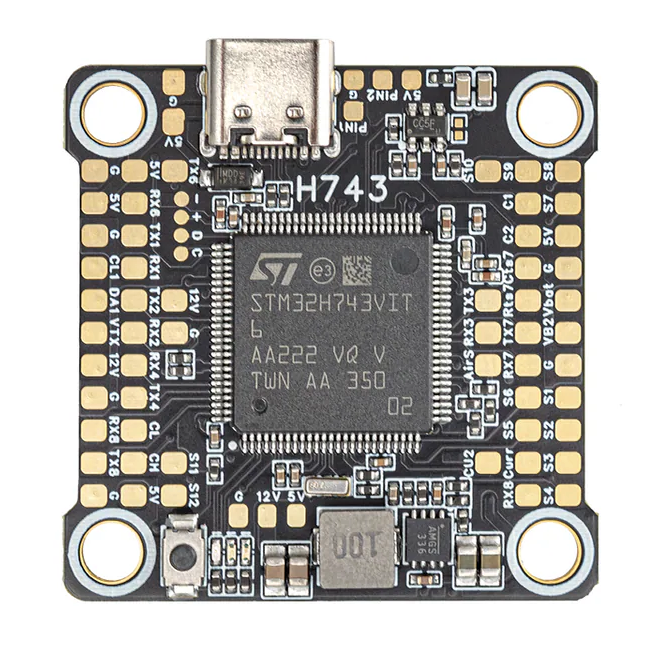
STM32 H7 Series: The new flagship. H7 processors (like the STM32H743) are dual-core and capable of even higher clock speeds and memory capacity. They are designed for the most demanding applications, such as running high-definition digital video systems (like DJI O3) while simultaneously performing advanced GPS navigation, optical flow, and complex telemetry. They also support DShot3000 for ultra-fast ESC communication. The H743-SLIM V4 is a prominent example in this category (and the model mentioned in our earlier discussion).
Gyroscope Choice: The Sensor That Defines Feel
The gyroscope (gyro) is arguably the most important sensor on the FC, as it directly measures the drone's angular velocity. Different gyro models have different characteristics that affect flight feel:
MPU6000: The industry veteran. Known for its excellent noise performance and reliability. It communicates over an SPI bus and is capable of 32kHz sampling. Many pilots swear by the MPU6000 for its "smooth and analog" feel, even if it is no longer considered the absolute newest chip.
ICM20602: A smaller, lighter, and more affordable gyro that became popular in micro drones. It offers good performance but is more susceptible to vibration interference than the MPU6000.
ICM20689: An improvement over the 20602, offering better noise filtering and higher resolution. It is a common choice for mid-range and some high-end FCs.
ICM42688P (and ICM42605): The modern state-of-the-art. These gyros offer extremely low noise, high resolution, and excellent temperature stability. They are the current gold standard for high-performance FPV, providing an exceptionally clean signal that enables smoother flight and more aggressive tuning. Many newer FCs, including the Matek H743-SLIM V4, utilize this gyro.
Feature Differentiation: What Else Does the Board Offer?
Beyond the processor and gyro, flight controller models differentiate themselves through their onboard features and peripheral support:
Barometer (Pressure Sensor): A barometer measures altitude by sensing air pressure. This is essential for altitude hold modes, GPS rescue features, and applications like waypoint navigation. While pure acrobatic pilots often do not need it, long-range and cinematic pilots consider it a must-have.
Blackbox Memory: Most FCs have a small onboard flash chip for logging flight data. Larger memory (typically 8MB or 16MB) allows longer recording times, which is vital for tuning and crash analysis. Some boards also support an external microSD card slot for even larger storage.
Integrated OSD (On-Screen Display): Almost all modern FCs have a built-in OSD chip (usually the AT7456E) that overlays telemetry data (voltage, current, time) onto the video feed. This feature is universal, but some premium boards offer a higher-resolution or more customizable OSD.
UART Ports (Universal Asynchronous Receiver-Transmitters): These are the communication ports used to connect external peripherals. A typical FC might have 4 to 7 UARTs. The number of available UARTs is critical for complex builds that require a receiver, GPS, compass, airspeed sensor, and an HD video system simultaneously.
Current Sensor: Most modern FCs have an onboard current sensor that measures the current draw from the battery. This data powers the "mAh used" reading on the OSD, allowing pilots to track battery consumption accurately.
Voltage Regulators (BEC - Battery Elimination Circuit): The FC must step down battery voltage to a stable 5V and sometimes 9V/10V to power peripherals like the receiver, GPS, and even the VTX. Higher-quality BECs provide more stable power, reducing noise and protecting sensitive components.
DJI / HD Plug: Many newer FC models feature a dedicated plug (often a 6-pin or 8-pin connector) for easy plug-and-play connection to digital video systems like the DJI Air Unit, Caddx Vista, or Walksnail Avatar. This simplifies wiring and reduces clutter.
How to Choose the Right Model for Your Build
To select the ideal flight controller, consider the following questions:
What is my frame size? Match the form factor to your mounting pattern. (30.5mm for 5-inch, 20mm for 3-inch, 25.5mm for whoops).
What is my flying style? For racing and high-performance freestyle, an F7 or H7 with an ICM42688P gyro is recommended. For casual cruising or beginner practice, an F4 is excellent and more affordable.
What peripherals will I use? Do you need a barometer (for altitude), 7 UARTs (for GPS + Compass + HD + receiver), or a DJI plug? Choose a board with the right peripheral support.
What is my budget? F4 boards are significantly cheaper than H7 boards. There is no shame in starting with a solid F4, upgrading later when your skills demand more performance.
The Future of Flight Controllers
The trend in flight controller models is moving toward higher integration and more powerful processors. AIO boards are becoming increasingly common, combining the FC and ESC (and sometimes the receiver) into a single tiny board for ultralight builds. H7 processors are slowly becoming the new standard for flagship models, enabling features like edge computing and more sophisticated filtering algorithms. Additionally, we are seeing improved vibration isolation designs, with many boards now featuring soft-mounted gyroscopes directly on the PCB to reduce noise from the frame.
Conclusion
FPV flight controllers are not a one-size-fits-all component. From the humble F4 to the powerhouse H7, from 25.5mm whoop boards to full-size 30.5mm stacks, each model is a carefully engineered solution to a specific set of requirements. By understanding the differences in processors, gyros, form factors, and peripheral features, you can make an informed decision and select the command center that perfectly matches your drone's size, your flying ambitions, and your budget. The right flight controller is the foundation of a great build—choose wisely, and your quad will reward you with flawless performance.

 English
 Français
 Español
 Русский
 العربية
 Polski
 українська
 Nederlands
 Português
 Deutsch
 Hrvatski
 italiano
 Gaeilge
 Dansk
Dansk Norsk
Norsk magyar
 Suomi
Suomi Türkçe
 Eesti keel
 日本語
日本語 한국어
한국어 Tiếng Việt
 ไทย
ไทย አማርኛ
አማርኛ ພາສາລາວ
 ភាសាខ្មែរ
 Bahasa Melayu
 ဗမာစာ
ဗမာစာ தமிழ்
தமிழ் Filipino
 Bahasa Indonesia
 Română
 Čeština
 Монгол
 қазақ
қазақ Српски
 हिन्दी
 فارسی
فارسی Kiswahili
 Slovenčina
 Slovenščina
 Svenska
 Ελληνικά
 Հայերեն
 עברית
עברית Latine
 اردو
اردو Shqip
Shqip বাংলা
বাংলা Afrikaans
 Māori
Māori